Denis Ribas — About
About
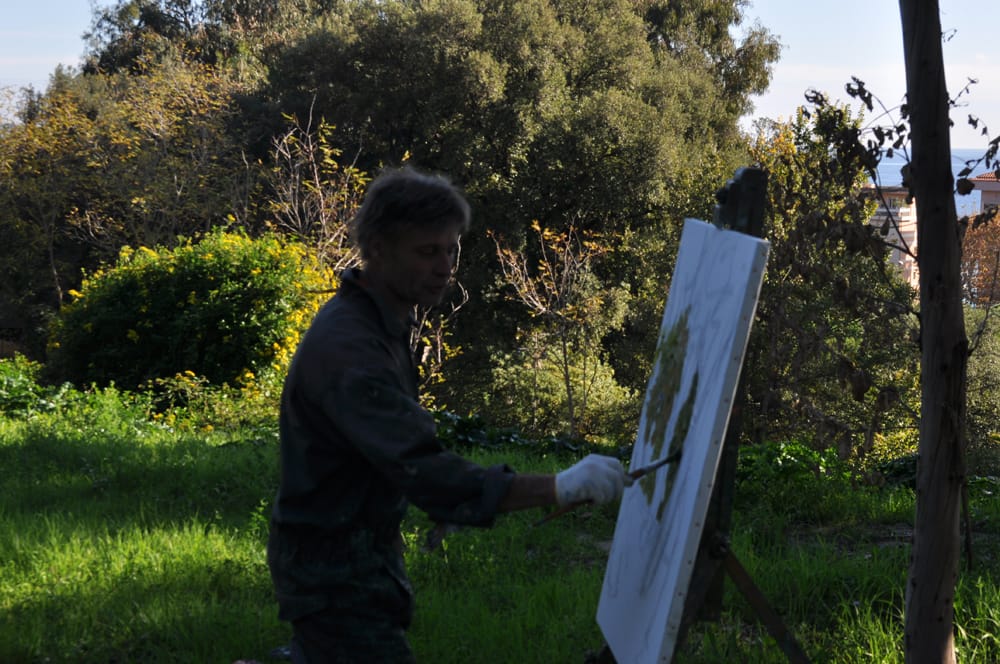
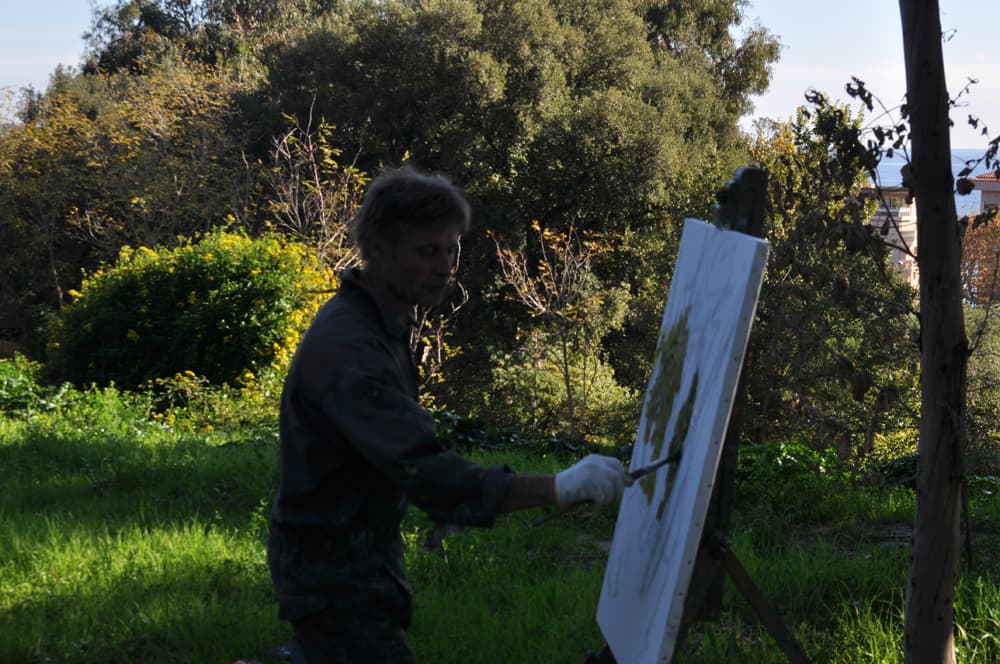
Landscape painting, painted outdoors and on site
THE RELATIONSHIP WITH CLIENTS There can only be a privileged relationship between Denis Ribas and his potential clients. Denis takes their opinions into account because the gaze towards painting does not always need to be professional. This is the aspect that a gallery cannot offer him. This emotional bond with the client has always mattered enormously to him. Some of them have become, from the start, sincere and unconditional friends of his work. Each contributes, to the extent of their possibilities, to the support of his Work. GUESTBOOK Watching Denis RIBAS paint in the Alpilles remains a delightful and unique spectacle. Bursting like lightning from his vehicle, in which hundreds of tubes of paint are piled, the artist crushes those he has instinctively chosen with his claws onto the palette, then flings them onto an immense cloth spread over the lush grass. His paint stretches and flows from his fingers. With the frame on his knees, he fixes the landscape with a troubling and unnerving gaze. I would even say piercing and penetrating, like a falcon hunting the color nuances of the wooded areas and meadows surrounding him. His head tilted to the side, his aquiline nose, his mouth drawn in, his cheeks furrowed with vertical wrinkles—he has come from afar to seek the light of Provence. It hypnotizes and transcends him. After a few swift strokes of charcoal, bursting forth like lightning, the trees take shape. Nature, nourished by a transparent light, begins to move. The olive grove dons robes of colors he renders electric until they explode. The leaves stir and rustle. The mistral and the cicadas become audible. Like a rhizome that has withstood time, Denis Ribas seems to have conquered his powerful and prodigious style after having drunk from a mysterious sap. A juicy nourishment rising from his deep roots anchored in the same earth where Van Gogh once painted. Linked to this genius by a pulsating umbilical bond, his inner journey reproduces pictorially, in a contemporary manner, the scent and warmth of the earth, the allure and grace of sunflowers, the whisper and dance of cypresses, the fragrance of lavenders, up to the dazzling sun. The softness of his hands, his generosity, his sensitivity, his poetic breath, and his vision piercing reality transform pigments into an offering destined for the viewer: a representation of nature metamorphosed into a work of art. Why classify it? If not to give the desire to contemplate it and feel the dazzlement it provides. I would call this expressionist hyperrealism. — Jean Marc Boulon, Van Gogh specialist, chief physician at the St Paul de Mausole hospital in St Rémy de Provence Denis, it’s after life that you run, the only one, the true one. Always elsewhere, always here, infinitely. With the constant concern for perfect instability, subject to risks and hazards, to all those nagging abrasions capable of bringing beauty to its knees. — Text from the La Rochelle Exhibition One no longer contemplates the paintings of Denis Ribas, one listens to them.. — Anonymous testimony When the physical power of the man transforms into the power and softness of a painting. Denis Ribas is today one of the rare outdoor painters with a surprising artistic expression, much like the man himself. Beneath a robust and powerful physical exterior, one discovers a gentle sensitivity that expresses itself on canvas, always cradled by the external elements—rain, sun, wind, dew, cold, heat. His painting and colors, like his soul and spirit, are vivid, authentic, and pure. His very powerful work, with its generous material, is not without recalling the painting of Van Gogh during his Arles period and more particularly the year 1889, Soutine for his painting inspired in this same region of Céret, or even the Fauvist period of Maurice de Vlaminck... A very endearing character, Denis Ribas offers us a painting of rare power, of rare sensitivity, for the undoubted happiness of collectors and museums. — Laurent Auzeric — Art Patrimoine If RIBAS were Gascon, D'ARTAGNAN would rhyme with descendant. A braggart, he is, a braggart, he will remain. With a heart this big. His brushes serve him as swords with which he skirmishes. He loves people. Those who do not leave one indifferent. But he is Catalan and paints nature, of which he is the lover. — Alain Kuntz — « Si Ribas était Gascon… » Denis, Sometimes, I feel a bit guilty for telling you what transports me about your canvases. And truly with the things you're very good at. Beyond what you usually do, I find that the effects of water, wind, clouds, the power of nature are your strength. You really manage to express them. Completely opposite to the flatness of a string of painters who absolutely can't bring anything out. Let your vigor speak and express the power within you. But that must be exhausting too, perhaps? — François Cariou — « Ce qui me transporte chez Denis Ribas » Once again, some of your canvases seemed remarkable to us, one in particular where you brilliantly interpreted the large water lily pond. It's MONET... This work on the water's reflections with the short dabs of color form a painting within the painting itself... contrasting with the brushstroke of the sky, which seems aggressive given how restful the serenity of the water is... What amazes me about you is that you always have something to deliver, and one day, without even realizing it, you're capable of producing one of those paintings your friend Bernard described as "Van Gogh quality" because it evoked the same intensity of emotion in the public. The brushstroke has forgotten to age... and the painting renews springs in the memory of the public, who for a few moments becomes optimistic again. One day, I'll linger a bit more on deciphering the form, composition, and color. I'll need to observe and analyze several paintings and find the common denominator that triggers this impression.... It's certainly an alchemy, but an alchemy whose exact components we can't find, yet which can reveal to us, through a gradual ascent from the work in black to the work in yellow, the harmonic climate that awakens these feelings in the viewer. I know you'll find this analysis pointless, saying you just paint, that's all...... But one day, I did an analysis among my brothers about "raw stone." Most started from the pejorative principle of this state, which only asked to evolve and be worked to become positive..... Where the chisel was the key..... I pointed out that the chisel was active in relation to the material but passive in relation to the mallet, which was itself passive in relation to the arm, which in turn became passive in relation to the brain, each of these objects having been both active and passive until becoming sovereign of the final stage: THE SPIRIT... So I asked how the spirit could qualify matter, which, like us, was made of stardust... whether they would see raw stone in the same way.... So, will you say, what's the connection to my painting? Well, Denis, it's that something in art—this spiritualization of the world—escapes us, and the one who creates or the one who observes is caught in the same vertigo that no one can control..... So when I tell you there's something in you that needs to come out, it's like the question of that sculptor's son who had just finished a magnificent rearing horse and asked his father: "Tell me, Dad, when they delivered that big rock to the garden, how did you guess there was a horse inside?" I just spent a pleasant moment with you, Denis, but you're worth it. I kiss you, — Jacques Ribas (his uncle) — « Lettre à mon neveu » Strength, weakness, tenderness, construction, reconstruction..... fulfillment? A man's life. A fine speech, the one at Solliès-Pont: a beginning where you explain your reluctance to hold an exhibition in that place. Then the reasons for your choice, the sincerity of the relationships, and the deal with just the right amount of audacity. Then your story, your journey to painting. Your approach, all in reserve, restraint, even distance. The evocation of your father's words, words you make your own. Then the hope that you'll touch their hearts, for that is the primary motivation. A painting must tell a story. What better story than the one we tell ourselves. This certainly explains the success of your "paths," in which everyone chooses their own adventure. Painting is like writing. A way to make one's dreams come true. You should pay more attention to your skies. You have some sublime ones and others weaker at times. They can serve to enhance foliage, a detail, a colour. It's a shame that a painter of nature like you sometimes forgets, as they are also an integral part of nature. Painting is realising one's sensations. In your summer landscapes there is some Cézanne, with more shadows. — Patrick Gastaldi — « Denis Ribas, une Vie d'Homme » A passionate lover of colour, of the vigour of that untameable space of nature: Denis Ribas represents the wind when it blows, that blazing sun when the sun is at its zenith, the heaviness of the sky when the clouds are laden, and that tranquillity when nature is less impulsive. And the scents of this earth, mingled with a thousand vibrant fragrances carried by the air—he paints those too. Denis Ribas pleases because he is true, because he embraces this earth, this sky, these trees, and it matters little to him if others have achieved it before him or will one day achieve it as he does: his paintings are above all selfish transpositions of intensities he feels deep in his flesh. He transcribes through his brushes that force which will outlive us, far beyond our fleeting and instinctive death, like a fiery animal in tune with these spaces of freedom. This is what captivates those who know how to understand his painting. — François Cariou — « Denis Ribas, passion couleur » Painting as one spits into the wind, as one fells a tree, as one more foolish bet, as an insult. The man is there, before me, restless, voluble, changeable, elusive, imponderable for he never weighs. This tiger has the lightness of a dragonfly, of a will-o'-the-wisp. He blows up the backside of this Catalan, through his open windows that are his canvases, a tramontane of all the devils that fills his space and our dreams. Oil painting if ever there was one, rich, more kneaded than laid. Fevers of ultramarine, impulses of madder, greens! Where does he get those greens? "From nature, of course!" he says, with the laugh of a mischievous child, not without having kneaded your forearm as a sign of brotherhood. This nature-refuge, matrix, confidante, where, as a kid, he would retreat—today he paints it, nature. Outdoors, in situ, in solar afternoons, mano a mano, in the open air, devouring the earth and inhaling it, embracing the great trees. I have seen in his paintings plane trees with blue trunks dancing the sarabande—Soutine is not far off—solid clouds, alizarin vineyards bearing the hope of wine, almond trees with mica-schist flowers... Talk to him about rain, talk to him about fine weather, about wine, and the scents of earth after the shower, but, please, do not talk to him about his art, the wild beast has little taste for ready-made compliments. Wild, with rage in his teeth, to the very tip of the brush, opening his tubes of paint as one pulls the pin from a grenade. For wild he is, and he persists and signs: Denis Ribas. per molts anys — Marc Trabys — « Prélude à l'après-midi d'un fauve » He travels through the world's capitals, exhibits, and sometimes certain encounters are magical—a meeting of minds, a mutual empathy established with manager Alain Kok, director of the Royalton hotel. He saw the canvas and had an irresistible impulse. He is an erudite Chinese man whose culture is steeped in nature, trees, and flowers, so of course, Denis was his man—he who plants his easel in nature and paints with spirituality and sensitivity what he sees: the landscape, the light, the colours, that is his entire lush and rich universe. Here, these are the tones of autumn, the ochres and reds, the greens altered by shadows, a sunken path, and it is « Chemin de Provence aux abords d’un golfe. » Alain Kok is struck by what cannot be explained as emotion in front of this painting, but it can be called a trigger for desire. He wants it in the hotel hall, but large, very large. A fresco, a small piece of a landscape from the South, a landscape that will be 6 metres high and 4.80 metres wide. « I am a man of challenge, » says Denis. And so this bilious warrior rises to the challenge, finds a cherry picker, sets up his colours, and gets to work, tracing the perspectives and rolling up his sleeves. He paints for a week, driven by the challenge this pictorial work represents. It is a monumental fresco, a place of truth that is called the mark, the recognisable « touch » of this naturalist painter from Céret, Denis Ribas, « Writer of images, » as he says. — Fanny di Francesco, Journal l'Indépendant — « Denis Ribas, the painter of the extreme » "You must be coherent between what you show and what you say. It's beautiful. Your hues are beautiful. You are caught by a classicism; there is a playful, commercial side that you have understood very well: you must be very great at that. You have a great capacity for structure. You have a liveliness of line: impressive." "It's everything I hate, but in fact, when you analyse it, you go to the essential: you want to be inside it. There is an appearance; there is always something passionate in your painting. Your writing is not in what is seen. You master it seriously." "There is great freedom: you are very free. And you add to it because you know you have to feed yourself with it. You have the rare talent of wanting to please, knowing how to please, and selling. But only the talent in that should be remembered." "You have a writing style of your own. You know how to structure." "When you no longer have to sell, you will express yourself without a problem. You've grasped light and colours." "And above all, you don't take yourself seriously. That's the main thing." — Bruno Kiep — « About the work of Denis Ribas » First, there is the man... lofty, obstinate, a bit capricious, brilliant. Destined for something else, he was supposed to heal; today, he does good. His dormant talent caught up with him, gnawed at him, compelled him... He crowds, strides, never stops giving. Only exhaustion knows how to stop him. He met a Lady, Lady Nature; she offered herself. He simply allowed himself to borrow her, to hem her, and since then, he has never stopped thanking her. To her, he found the crack of emotion, the one that nails you, plays on the ache of having thought about it a little too much, leaves you stranded without really knowing why, and sometimes even frees you when it takes you there, or at least once, where you wanted to lose yourself. Denis is not just capable, he succeeds. His gestures are frank and so unjustly easy that once, I almost hated him. I have often told him that I had nothing more to say to him, that I could no longer pay him compliments—he deserves so many! His painting is as generous as the man is. I saw his astonishment when he learned, smiling, that his gift, now, is no longer to paint, but to 'touch'... I looked at him closely: his place is there; elsewhere would be to condemn him... I searched for a long time and I found: 'the river,' 'the wood' on my walls, unchanging, irreplaceable. I raise my glass to his courage, that of his battles, of his dark-ringed eyes where, somewhere in a sky, he no longer even knows what time it is. I looked at him again, and perhaps I even understood him, or was it him who let me understand?... — S.